Hi! I’m Antonella Nonnis, but people call me Ant, a User Experience Design Lecturer and Y2 Lead for the BA UXD students in the Design School at LCC. I hold a (fully funded) PhD in Media and Arts Technology from the School of Electronic Engineering and Computer Science of Queen Mary University of London.
My research explores how a more inclusive research and design approach to technology for play could benefit marginalised children, such as non-conventionally verbal autistic children. The focus of design is not just on the technology but on the environment created and the experience and opportunities offered, including neurotypical researchers’ attitudes towards and appreciation of neurodiversity.
My interdisciplinary works have been exhibited nationally (London, UK) and internationally (USA, EU). I have a good publications record, and my research was published and presented at high-level academic international conferences such as the ACM Conference on Human Factors in Computing Systems (CHI) and journals such as the ACM Transactions on Computer-Human Interaction (TOCHI) and the International Journal of Human-Computer Studies (IJHCS) and other middle-level international conferences such as the Interaction Design and Children (IDC), where the work won the Best Demo Award, and the New Interfaces for Musical Expression (NIME). I co-authored a workshop exploring design fiction and absurd making for critical NIME design that won the Best Workshop Prize. Finally, I provide peer-reviewed publications submitted to CHI, TACCESS, NIME, TEI, and IDC. In 2021, I received Special Recognition for Outstanding Reviews for CHI 2021 Papers.
I started teaching in HE 7 years ago while doing my PhD at QMUL. I came to LCC in the winter of 2022 where I taught the Interactive Data Visualisation Studio to the Y2 BA UXD students for one winter term. I came back in 2023 to teach Enquiry in Design for User Experience (Y2), the Final Project and the Competition Brief units (Y3) for the whole academic year and ended up staying :). In my previous teaching role as a visiting lecturer at City University, I taught the Inclusive Design module to MSc students and co-taught the Creativity in Design module with the fantastic Dr Alex Taylor and Dr Sarah Heitlinger. I also assisted with lab work and marking for the Understanding User Interactions module with the patient Dr Stephann Makri and the Evaluating Interactive Systems with the amazing Prof Steph Wilson. At Queen Mary University, instead, I was a Lab Demonstrator/Assistant Lecturer for 3 years for Interactive System Design with the fantastic Prof Paul Curzon and Prof Matthew Purver.
In my current and previous teaching roles at LCC, QMUL, and City University, I planned and delivered learning activities for BA and MA/MSc students, focusing on creative, human-centred, critical, ethical, and inclusive approaches to design screen-based, physical, remote, and/or situated experiences. My teaching philosophy centres around fostering a collaborative and inclusive learning environment that encourages students to learn, explore and apply ethical and inclusive human-centred design processes across digital and analogue media.
By doing the PGCert I hope to develop the skills and knowledge needed to create a more inclusive and supportive learning environment where all students can thrive. I aim to foster a space where students feel empowered to be creative, experiment with new ideas, and take risks safely and constructively. Additionally, I want to enhance my teaching practices to not only guide students in their design and research journeys but also to encourage their growth as human beings, independent thinkers, tinkerers and creatives, and to build their critical and analytical skills as well as strengthen their socio-emotional resilience so that they are better equipped to navigate challenges and flourish both academically and personally.
Zine produced as an outcome of the workshop run on the 18th of February 2026. The last page of the zine shows QR code that links to the resources created from the workshop
As outlined in the Research Methodology post, Data Generation: Cycle 1, section of this blog, a total of four participants contributed feedback on the designed artefacts. The feedback was collected from one BA student and three staff members, comprising one Microsoft Teams transcript (discussion-based feedback) and three written responses (emails and documents). The original names of staff participants are reported, while a pseudonym has been used for the student participant.
Given the nature and timing of the data collected, this stage of the project sits within the scope of formative evaluation and design-oriented feedback analysis, alongside pedagogic reflection. In light of the scope, resources, and timeframe of the intervention, and for the purposes of the PgCert submission, I conducted a light qualitative content analysis (Braun eta l., 2023; Ahmed et al., 2024; Friedman and Hendry, 2019; Kara, 2015) to examine formative feedback on the workshop materials, resources, and overall workshop concept, as presented below.
This analysis constitutes the first cycle of the ARP, while the workshop event planned for 18 February 2026 will be treated as a second iteration. Findings from this second iteration will be analysed following a similar approach to this, as outlined in the Research Methodology section. A written mid-term report and a final report will be submitted to EDI on 31 March 2026 and 30 June 2026 respectively, detailing progress against the agreed milestones.
The qualitative content analysis below presents a single consolidated coding framework that integrates feedback from staff and student into a coherent and methodologically rigorous account. The analysis remains descriptive and data-led. I do not smooth over tensions between sources; where perspectives differ (staff vs student), this is made explicit in the coding.
Findings
Data sources:
Valerie (staff, in-depth verbal feedback)
Emma (staff, written feedback)
Jess (staff, written reflective feedback)
Maya (BA student, written feedback + follow-up)
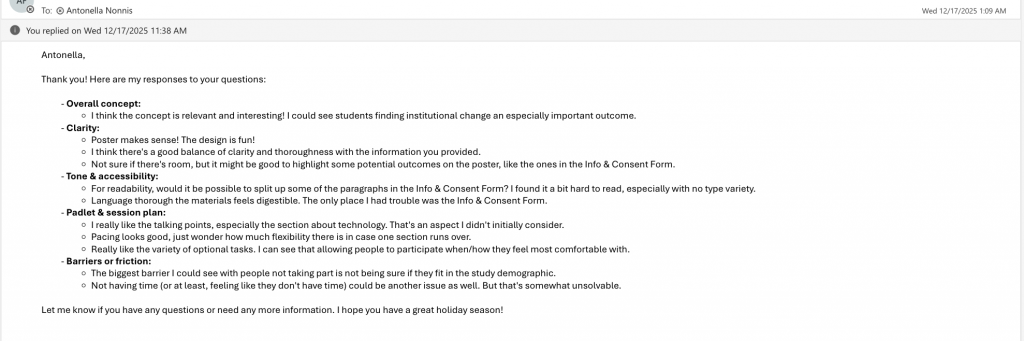
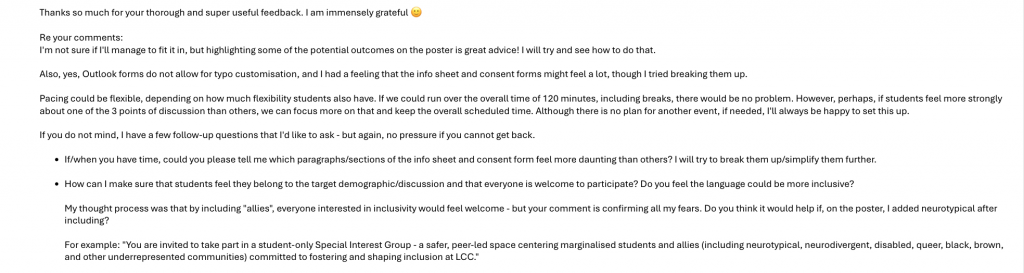
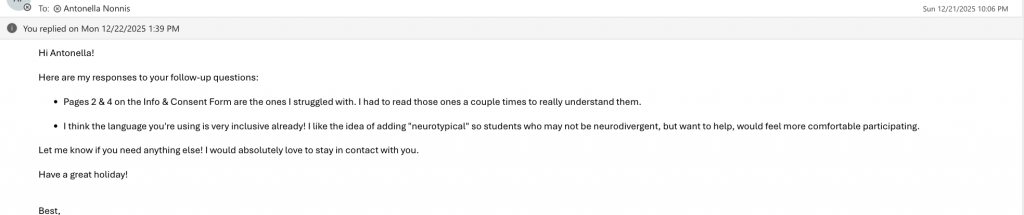
The raw data uploaded below show the 1 transcript of the Teams open discussion I had with Valerie and the email exchanges with replies to questions from Emma, Jess and Maya.
I contacted Emma twice. Initially I asked her some feedback on the info sheet and consent form, Padlet, and the poster (round 1). I also contacted another colleague and an MA student via Teams but, though they offered to help, I received no replies. The latter sent a later Teams message explaining “Hello Antonella!! How are you? Sorry for the mega delay on this! I’ve been trying to decide on a mortgage, solicitor, property etc so I’ve been very busy but I would love to participate whenever you have a date penciled in!“. Then I sent another email sharing the intervention outline with step-by-step plan for the workshop, and the revised info sheet and consent form, the poster and link to Padlet (round 2). This latter email was the same sent to Valerie, a Senior Lecturer at LCC, Jess, a PgCert colleague working at LCF, and Maya a UXD student. An example of this can be seen from the below screenshot (second from the top). I also sent this email to a few Y1, Y2 and Y3 BA UXD students, but as mentioned, only Maya replied. Considering the short notice and the Christmas break I was confident to have enough information to help shape the design of the intervention to better suit students needs even with this small sample of (4) participants.
The verbal feedback with Valerie lasted 38 minutes and was automatically transcribed by and downloaded from MS Teams. The written feedback, was usually provided via inline comments. The feedback responded the following questions, which as mentioned, were shared with all participants via email:
Overall concept: Does it feel relevant, useful, and interesting?
Clarity: Does the poster make sense? Is anything confusing or overwhelming?
Tone & accessibility: Does anything feel off, too academic, or unclear?
Padlet & session plan: Does it seem like something students would feel comfortable engaging with? Are the activities engaging or not? Is the pace okay?
Barriers or friction: Is there anything that might make someone hesitate or feel unsure about taking part?
The consolidated framework presented below, has been generated from the raw data displayed above. Responses were analysed using a qualitative content analysis approach, focusing on recurrent themes related to relevance, clarity, tone, accessibility, and perceived engagement among other. Given the small sample size and the formative purpose of this data collection (piloting materials rather than evaluating participant experience), this approach was selected to support reflective iteration rather than theory generation. A thematic analysis of values such as belonging, inclusivity, empowerment etc.. has been coded mostly explicitly from the data (Wæraas, 2022).
Consolidated Coding Framework
I started the coding process considering my existing questions as initial categories but I then tailored them to the data:
Relevance / usefulness
Suggestions / concerns
Clarity of materials
Tone & accessibility
Comfort & safety
Engagement & pacing
Pictures of the printed raw data used for analysis are attached below.
8 Main Themes (A – H) were generated from the analysis:
Theme A: Perceived relevance and value of the intervention
Theme B: Scope, focus, and feasibility
theme C: Clarity and accessibility of materials
Theme D: Tone, language, and framing
Theme E: Padlet, activities, and engagement
Theme F: Inclusivity, accessibility, and lived experience
Theme G: Barriers to participation
Theme H: Recruitment, dissemination, and sustainability
Quotes from participants were extracted as illustrative evidence, code labels and descriptors are all shown for each of the Themes generated in the below tables (Theme A to Theme H).
Code
Code label
Description (merged)
Sources
Illustrative evidence
A1
Intervention relevance
Intervention perceived as relevant, useful, and timely
All
“really great project” (Valerie); “relevant and interesting” (Maya)
A2
Institutional value
Seen as having potential impact beyond the session
Valerie, Jess, Emma
“useful for the university” (Valerie); “co-created spaces” (Jess)
A3
Empowerment potential
Session framed as empowering student voice
Valerie, Jess
“giving them a voice” (Valerie); “fosters empowerment and community” (Jess)
Theme A: Perceived relevance and value of the intervention
Code
Code label
Description
Sources
Evidence
B1
Risk of over-scope
Concern that intervention covers too much
Valerie, Emma
“it’s a lot” (Valerie); “trying to do too much” (Emma)
B2
Need for prioritisation
Suggestion to reduce or select fewer topics/questions
Valerie, Emma
“maybe keep maybe one one question” (Valerie); “focus on one area” (Emma)
B3
Time constraint awareness
Recognition of limited session time
Valerie, Emma
“very limited time” (Valerie); “hard to know how much you’ll get through” (Emma)
B4
Flexibility within plan
Desire for adaptability emphasised
Valerie, Maya
“keep maybe one one question or two for each section and then use the the others as as prompt only if you need to” (Valerie); “wonder how much flexibility there is” (Maya)
Theme B: Scope, focus, and feasibility
Code
Code label
Description
Sources
Evidence
C1
Poster clarity
Poster content understood and accessible
All
“poster itself was really clear” (Valerie)
C2
Visual design supports access
Visual elements aid navigation and tone
Valerie, Jess, Maya
“easy to navigate” (Valerie); “calm and welcoming” (Jess);
C3
Information density
Materials perceived as content-heavy
Valerie, Emma, Jess
“a LOT of content” (Emma); “5 pages felt a bit daunting” (Jess)
C4
Information sheet and Consent Form readability
Mixed readability; some sections demanding
Valerie, Maya
“requires more reading” (Valerie); “hard to read” (Maya)
C5
Specific clarity gaps
Missing or unclear information identified
Valerie, Jess
contact details (Valerie); “What does SIG stand for?” (Jess)
C6
Repetition for usability
Repeating key info such as contact details improves accessibility
Valerie
“might as well repeat it”
theme C: Clarity and accessibility of materials
Code
Code label
Description
Sources
Evidence
D1
Appropriate tone
Tone perceived as balanced and suitable
All
“all good” (Emma); “can be taken seriously” (Jess) “feels digestible” (Maya)
D2
Formality as legitimacy
Formal tone seen as conferring seriousness
Jess
“gives you the sense that this is proper and can/will be taken seriously”
D3
Framing risks
Wording may unintentionally alienate
Jess
“‘Staff will be excluded’… does this imply staff will be a threat?”
D4
Inclusivity of language
Language generally inclusive
Maya, Jess
“language… inclusive already” (Maya) “they are really well judged and accessible questions I think” (Jess)
D5
Demographic ambiguity
Uncertainty about who the session is for
Maya
“The biggest barrier I could see with people not taking part is not being sure if they fit in the study demographic”
Theme D: Tone, language, and framing
Code
Code label
Description
Sources
Evidence
E1
Padlet comfort
Padlet perceived as safe and accessible
Valerie, Emma, Maya
“Padlet yes” (Emma); “so the padlet is for you to collate information…I’ll get that. That’s fine…if it’s for you to upload stuff, then that’s fine, but they will be uploading only” (Valerie)
E2
Tool purpose clarity
Need to clarify Padlet’s role
Valerie, Jess
“what is it for exactly?” (Valerie)
E3
Multimodal participation
Value of varied participation formats
Valerie, Maya
different modalities “I think it’s a great idea” (Valerie) “really like the variety of tasks” (Maya)
E4
Engagement of activities
Activities seen as engaging
Emma, Maya
“engaging” (Emma); “really like the talking points” (Maya)
E5
Visibility of questions
Suggestion to foreground questions
Jess, Valerie
“make them a little bigger” (Jess) “will you have some of your questions on padlet before you send it to them because ..I know that I always struggle with that when people ask me big questions and I have to think on the cuff like that I need to” (Valerie)
Theme E: Padlet, activities, and engagement
Code
Code label
Description
Sources
Evidence
F1
Cognitive accessibility
Need for reflection time acknowledged
Valerie
“prefer to have the questions before” (Valerie)
F2
Conflicting access needs
Recognition of divergent accessibility needs
Valerie
“different people with different disabilities will have sometimes conflicting needs” (Valerie)
F3
Policy–practice gap
Gap between policy and lived experience
Valerie
“and their idea of helping of supporting disabled people was to basically, and I don’t think the university did” (Valerie)
F4
Accessibility as systemic
Barriers framed as institutional, not individual
Valerie
“it was unfair on her as well because she was feeling like, really awkward about it.”
F5
Belonging and allies
Need to explicitly welcome allies
Maya
“adding ‘neurotypical’ would help”
Theme F: Inclusivity, accessibility, and lived experience
Code
Code label
Description
Sources
Evidence
G1
Time as barrier
Time pressure discourages participation
Maya, Valerie
“feeling like they don’t have time” (Maya) “It’s a tricky time because they’ve got deadlines” (Valeire)
G2
Uncertainty about fit
Hesitation due to unclear eligibility
Maya
“not sure if they fit”
G3
Cognitive overload
Volume may overwhelm participants
Valerie, Maya
“it’s covering a lot” (Valerie) “..would it be possible to split up some of the paragraphs” (Maya)
G4
Language misinterpretation
Risk of wording causing discomfort
Jess
“staff will be excluded”
Theme G: Barriers to participation
Code
Code label
Description
Sources
Evidence
H1
Recruitment complexity
Recruitment recognised as difficult
Valerie, Emma
“no magic way” (Valerie) “At the end of the day it really just depends what students you get for your session.” (Emma)
H2
Multi-channel recruitment
Value of posters, emails, face-to-face
Valerie
“I think that’s a great idea. Yeah. Yeah, yeah. I think so, because also it becomes more kind of, there’s already a connection” (Valerie)
H3
Timing sensitivity
Recruitment timing affects engagement
Emma
“tricky time of year” (Emma)
H4
Collegial support
Offers of help from colleagues
Valerie, Emma
“I could support recruitment” (Valerie)
Theme H: Recruitment, dissemination, and sustainability
Analysis
Across all sources, the consolidated data show strong agreement on:
High relevance and value
Strength of participatory, multimodal design
Need to manage scope, pacing, and cognitive load
Importance of clarity around belonging and inclusion
Risk of unintentional exclusion through wording
Differences emerge mainly between:
Staff focus: feasibility, institutional impact, scope, less info
Student focus: readability, belonging, demographic clarity, additional info
The analysis of the combined feedback reveals a clear and systematic distinction between how staff participants (Valerie, Emma, Jess) and the student participant (Maya) engage with and evaluate the intervention. These differences are not contradictory; rather, they reflect positional perspectives shaped by institutional role, responsibility, and lived experience.
1. Focus on feasibility versus focus on experience
Staff focus: Staff feedback is consistently oriented toward feasibility, manageability, and implementation constraints. Valerie and Emma repeatedly emphasise:
the risk of over-scoping,
limited time available within the session,
the practical challenge of managing complex discussions within institutional boundaries.
For example, Emma questions whether the intervention is “trying to do too much,” while Valerie repeatedly suggests reducing, prioritising, or staging questions due to time and cognitive load.
Student focus: Maya’s feedback, by contrast, centres on the experience of participation rather than delivery. Her concerns relate to:
readability of materials, suggested to “split up some of the paragraphs“,
whether she would feel she “belongs” in the study,
whether participation feels manageable alongside existing time pressures.
Staff evaluate the intervention as something to run; students evaluate it as something to enter. This difference highlights that feasibility for facilitators does not automatically translate into accessibility for participants.
2. Conceptual scope versus personal clarity
Staff focus: Staff engaged with the conceptual breadth of the project. Emma suggests narrowing the focus (e.g. concentrating on technology), while Valerie reflects on distinctions between “learning experience” and “student experience.” These reflections position the intervention within wider pedagogical, institutional, and research frameworks.
Student focus: Maya does not question conceptual framing at this level. Instead, her feedback focuses on:
which sections of the information sheet are hard to understand,
how paragraphs are structured,
whether terminology and framing clearly indicate who the session is for.
Staff assess conceptual coherence and research design; the student assesses immediate intelligibility. This suggests that conceptual clarity at a design level does not guarantee clarity at a participant level.
3. Institutional awareness versus demographic uncertainty
Staff focus: Staff demonstrate a high level of institutional literacy. Valerie and Jess reference:
policy constraints,
regulatory limits,
structural barriers beyond individual control.
Their concerns often assume familiarity with how institutions function and where power resides.
Student focus: Maya’s feedback reveals uncertainty about eligibility and belonging, expressed as:
“not being sure if they fit in the study demographic.”
She identifies this uncertainty as a potential barrier to participation.
While staff focus on what institutions allow, students focus on whether they are allowed to be present. This highlights that inclusion is not only structural but also symbolic and communicative.
4. Discursive framing: protection versus invitation
Staff focus: Jess raises concerns about the phrasing “staff will be excluded,” questioning whether this frames staff as a “threat” or implies prior silencing. This reflects a sensitivity to discursive positioning and institutional politics.
Student focus: Maya responds to framing in terms of welcome and reassurance, suggesting explicit inclusion of “neurotypical” allies to signal openness and welcoming.
Staff scrutinise how language positions groups relative to power; students attend to whether language invites or deters participation. Both are concerned with inclusion, but at different discursive levels.
5. Time pressure as logistics versus lived constraint
Staff focus: Staff refer to time as a logistical constraint:
limited session duration,
difficulty fitting content into allocated time,
recruitment timing around the academic calendar.
Student focus: Maya frames time as a personal and affective barrier:
“not having time (or at least, feeling like they don’t have time).”
Staff conceptualise time as a resource to manage; students experience time as a pressure that shapes willingness to engage. This difference suggests that designing for time efficiency alone may not address perceived burden.
6. Positivity and critique: balance versus entry safety
Staff focus: Both Valerie and Jess caution against an overly critically-focused approach, advocating for identifying “what works” alongside challenges. This reflects staff concern with:
actionable outcomes,
sustainability,
institutional learning.
Maya does not raise this issue directly. Her feedback implies that psychological safety and clarity are prerequisites before critique or positivity can even occur.
Staff seek balance in analytical outcomes; students prioritise safety and comprehension as conditions for participation.
The divergence between staff and student focus demonstrates that inclusive intervention design requires addressing two distinct but interconnected layers:
Operational inclusivity (staff perspective): Ensuring the intervention is feasible, bounded, institutionally aware, and capable of producing actionable outcomes.
Experiential inclusivity (student perspective): Ensuring participants feel they belong, can understand what is being asked of them, and do not experience unnecessary cognitive or emotional barriers to entry.
The data suggest that staff-designed inclusivity initiatives risk unintentionally reproducing exclusion if participant-facing clarity and belonging cues are not foregrounded alongside conceptual robustness.
Grounded in the findings, the intervention would benefit from:
Explicit signalling of who is welcome and why (student-led concern),
Continued scope management and prioritisation (staff-led concern),
Treating clarity, readability, and framing as core inclusion mechanisms, not secondary design features.
Following the suggested edits, raised issues, and friction points highlighted by the four participants the resources, including the poster, info sheet and consent forms, Padlet, and the workshop session outlined structure have been edited and simplified to hopefully enable student’s better experience once recruitment starts (around mid of January ’26). I still need to edit the poster following Maya’s suggestions to add to it. Maya liked the idea of adding “neurotypical” to let students who are allies feel more explicitly included and also said that “it might be good to highlight some potential outcomes on the poster, like the ones in the Info & Consent Form”. While I managed to add neurotypical to the poster I didn’t find the space to introduce the outcomes.
Discussion
This action research project set out to explore the design and feasibility of a student-led Workshop focused on inclusivity, accessibility, and institutional change within LCC. Feedback from staff colleagues (Valerie, Emma, Jess) and a BA student (Maya) reveals a productive tension between operational feasibility and experiential accessibility. It can be argued that this tension is not a limitation of the intervention, but rather an expression of the power relations, epistemic positions, and value negotiations that shape participatory work in higher education.
By situating these findings within existing literature on student voice (Wolgemuth et al., 2024; Welton et al., 2022; Domínguez et al., 2022; Taylor and Robinson, 2009), intersectionality (Crenshaw, 2013; Le, 2024; Brontsema, 2004), inclusive design (Friedman, and Hendry, 2019; Hanington and Martin, 2019; Milton, Martin and Melham, 2016; Lidwell, Holden and Butler 2010), and participatory research (Burke, 2013; McTaggart, Nixon, and Kemmis, 2016), and following Wæraas’ (2022) discussion of values work as the ongoing articulation and negotiation of values through texts, the intervention can be understood as a site where values around inclusion, care, and feasibility are made visible and contested.
Staff and student perspectives as situated knowledge
The analysis highlights a clear divergence between staff and student feedback, reflecting what Braun et al., (2023) describe as the situated and reflexive nature of meaning-making. Staff respondents primarily evaluated the intervention through lenses of scope, feasibility, time, and institutional constraint, while the student focused on belonging, clarity, and accessibility at the point of entry.
This distinction aligns with Ahmed’s (2012) critique of institutional diversity work, where those positioned closer to organisational responsibility often focus on what is possible within systems, while marginalised participants focus on whether those systems are habitable. Staff feedback reflects an implicit concern with delivery; student feedback foregrounds experience.
Rather than interpreting this divergence as disagreement, this analysis supports Taylor and Robinson’s (2009) argument that student voice initiatives must recognise unequal power relations and epistemic authority. The data suggest that staff and students are not responding to the same intervention in the same way, because they are not positioned equally within it.
Feasibility, scope, and the politics of containment
Staff concerns about the intervention “doing too much” resonate strongly with Macfarlane, Bolden and Watermeyer’s (2024) discussion of pragmatist leadership in higher education, where innovation must be tempered by institutional realities. Valerie and Emma repeatedly emphasise time constraints, cognitive load, and the risk of over-scoping, concerns that are legitimate within action research cycles that prioritise sustainability and iteration (McTaggart, Nixon and Kemmis, 2016).
However, these concerns also echo what Mountz et al. (2015) describe as the neoliberal compression of academic time, where participatory, reflective work must be justified through efficiency. The staff focus on containment contrasts with the student emphasis on whether the space feels safe and intelligible enough to enter at all.
This raises a critical question: feasible for whom? As Burke (2013) argues, access to higher education is not only about formal inclusion, but about the right to meaningful participation. An intervention that is operationally feasible but experientially exclusionary risks reproducing the very inequities it seeks to address.
Accessibility as relational, not just technical
Student feedback foregrounds accessibility not as a technical compliance issue, but as a relational and affective experience. Maya’s difficulty with specific sections of the information sheet, uncertainty about whether she “fits” the demographic, and concern about time all speak to what Lynch (2010) describes as the hidden labour of navigating uncaring systems.
This aligns with Milton’s (2012) “double empathy problem” and Rosqvist et al.’s (2022) work on epistemic injustice, which emphasise that misunderstandings around accessibility often stem from mismatched assumptions rather than individual ‘deficits’1. Maya’s request for clearer signals of inclusion (e.g. explicitly naming neurotypical allies) illustrates how belonging must be actively communicated, not assumed.
Staff participants, by contrast, tended to conceptualise accessibility in structural terms, policies, regulations, systems, mirroring Friedman and Hendry’s (2019) account of value sensitive design, where values must be surfaced and negotiated explicitly rather than embedded implicitly. The intervention therefore becomes a space where values around care, inclusion, and legitimacy are actively contested (Wæraas, 2022).
Student voice, power, and the limits of invitation
Both staff and student feedback engage with the politics of student voice, albeit differently. Staff emphasise empowerment and institutional learning, echoing Welton et al. (2022) and Domínguez et al. (2022), who caution that student voice initiatives often risk becoming symbolic if they do not redistribute power.
Maya’s hesitation about belonging suggests that being invited is not equivalent to feeling authorised to speak. This supports Boler’s (1999) pedagogy of discomfort, in which participation requires navigating fear, uncertainty, and vulnerability. The intervention’s framing as a “student-only space” was intended to protect participants, yet Jess’s concern about how this exclusion is phrased demonstrates how protective measures can inadvertently create new tensions.
This reflects Ahmed’s (2012) argument that inclusion often generates new forms of exclusion, particularly when boundaries are not carefully articulated. The data suggest that clarity of intent and clarity of invitation are as important as the structural design of the space itself.
Creative and participatory methods as ethical practice
The strong endorsement of multimodal activities, Padlet use, and flexible participation aligns with Kara’s (2015) and Wolgemuth et al.’s (2024) advocacy for creative and participatory qualitative methods. Both staff and student respondents valued the availability of multiple modes of engagement, reinforcing Ahmed et al.’s (2024) findings that visual and participatory methods can surface experiences that traditional verbal approaches may obscure.
However, Valerie’s concern about conflicting access needs highlights the ethical complexity of participatory design, echoing Fox’s (2025) and Le’s (2024) intersectional critiques of accessibility. Inclusion is not additive; it is negotiated, partial, and sometimes contradictory. Recognising this tension is itself a form of ethical reflexivity.
Implications for action research practice
From a critical participatory action research perspective (McTaggart et al., 2016), in my opinion, the divergence between staff and student feedback should not be resolved but held productively. The findings suggest that the next iteration of the intervention should:
Treat clarity, framing, and belonging cues as central design features rather than peripheral refinements.
Acknowledge time and scope constraints without allowing them to override experiential accessibility.
Make values explicit, particularly around inclusion, safety, and participation, rather than assuming shared understanding.
In this sense, the intervention functions not only as a pedagogical space, but as a micro-site of institutional critique (Pereira, 2017; Phipps, 2022), where the contradictions of inclusivity work in the neoliberal university become visible.
Conclusion
The differences between staff and student feedback do not indicate a failure of alignment, but rather expose the layered realities of inclusive pedagogical design. Staff focus on feasibility reflects institutional responsibility; student focus on belonging reflects lived experience. Bringing these perspectives into dialogue is not only necessary for the success of the intervention, but central to its ethical and political purpose.
As hooks (1994) argues, education as a practice of freedom requires discomfort, reflexivity, and a willingness to listen differently. This action research process demonstrates that inclusive design is less about perfect solutions and more about sustaining spaces where competing needs, values, and voices can coexist.
References:
Ahmed, M.F., Ali, K., Mann, M. and Sibbald, S.L., 2024. Thematic analysis of using visual methods to understand healthcare teams. The Qualitative Report, 6(29), p.1.
Ahmed, S. (2012) On Being Included: Racism and Diversity in Institutional Life. Duke University Press, Durham, NC.
Boler, M., 1999. A pedagogy of discomfort: Witnessing and the politics of anger and fear. Feeling power: Emotions and education, pp.175-203.
Brontsema, R. (2004) ‘A queer revolution: Reconceptualizing support for queer youth’, Journal of Gay & Lesbian Issues in Education, 1(2), pp. 25–40.
Braun, V., Clarke, V., Hayfield, N., Davey, L. and Jenkinson, E., 2023. Doing reflexive thematic analysis. In Supporting research in counselling and psychotherapy: Qualitative, quantitative, and mixed methods research (pp. 19-38). Cham: Springer International Publishing.
Burke, P.J. (2013) The Right to Higher Education: Beyond widening participation. Routledge, London.
Crenshaw, K. (2013) ‘Mapping the Margins: Intersectionality, Identity Politics, and Violence against Women of Color’, in Feminist Legal Theory. Routledge, London.
DeVito, M.A., Lustig, C., Simpson, E., Allison, K., Chuanromanee, T., Spiel, K., Ko, A., Rode, J., Dym, B., Muller, M. and Klaus Scheuerman, M., 2021, May. Queer in hci: strengthening the community of lgbtqia+ researchers and research. In Extended Abstracts of the 2021 CHI Conference on Human Factors in Computing Systems (pp. 1-3).
Domínguez, A.D., Clement, V. and Bertrand, M., 2022. The bind of unilateral power dynamics and youth voice in school politics. Educational Policy, 36(1), pp.169-198.
Fox, J., (2025). Neuro-queering feminism: Creating space within feminism to address autistic experiences of gender oppression. Feminism & Psychology, p.09593535241306532. (Accessed: 5 July 2025).
Friedman, A. and Nash-Luckenbach, J. (2024) ‘Resistance and power: Gender equality policies in universities’, Politics & Gender, 20(1), pp. 1–21.
Friedman, B. and Hendry, D.G., 2019. Value sensitive design: Shaping technology with moral imagination. Mit Press.
Hanington, B. and Martin, B., 2019. Universal methods of design expanded and revised: 125 Ways to research complex problems, develop innovative ideas, and design effective solutions. Rockport publishers.
Harris, K.A., 2022. Embracing the silence: introverted learning and the online classroom. Spark: UAL Creative Teaching and Learning Journal, 5(1).
hooks, b. (1994) Teaching to Transgress: Education as the Practice of Freedom. Routledge, New York.
Le, L., 2024, October. ” I Am Human, Just Like You”: What Intersectional, Neurodivergent Lived Experiences Bring to Accessibility Research. In Proceedings of the 26th International ACM SIGACCESS Conference on Computers and Accessibility (pp. 1-20).
Lee, C. et al. (2023) ‘The complexities of learner-teacher power relations in universities’, Journal of Higher Education Policy and Management, 45(3), pp. 301–318.
Lidwell, W., Holden, K. and Butler, J., 2010. Universal principles of design, revised and updated: 125 ways to enhance usability, influence perception, increase appeal, make better design decisions, and teach through design. Rockport Pub.
Lynch, K. (2010) ‘Carelessness: A hidden doxa of higher education’, Arts and Humanities in Higher Education, 9(1), pp. 54–67.
Kara, H., (2015). Creative research methods in the social sciences. (Vol. 10). Bristol: Policy Press.
Macfarlane, B., Bolden, R. and Watermeyer, R. (2024) ‘Three perspectives on leadership in higher education: Traditionalist, reformist, pragmatist’. Higher education, 88(4), pp.1381-1402.
McTaggart, R., Nixon, R. and Kemmis, S., 2016. Critical participatory action research. In The Palgrave international handbook of action research (pp. 21-35). New York: Palgrave Macmillan US.
Milton, D., Martin, N. and Melham, P., 2016. Beyond reasonable adjustment: autistic-friendly spaces and Universal Design. Pavilion.
Milton, D. E. M., 2012. On the ontological status of autism: The “double empathy problem.” Disability and Society 27, 6 (2012), 883–887.
Mountz, A. et al. (2015) ‘For Slow Scholarship: A Feminist Politics of Resistance through Collective Action in the Neoliberal University’, ACME: An International Journal for Critical Geographies, 14(4), pp. 1235–1259.
Pereira, M.D.M. (2017) Power, Knowledge and Feminist Scholarship: An Ethnography of Academia. Routledge, London.
Phipps, A. (2022) Women in Academia: What’s the Problem? Policy Press, Bristol.
Redman-MacLaren, M., Mills, J. and Tommbe, R., 2014. Interpretive focus groups: A participatory method for interpreting and extending secondary analysis of qualitative data. Global Health Action, 7(1), p.25214.
Rosqvist, H.B. et al. (2022) ‘Neurodivergent Academic Experiences: Intersections of Ableism and Epistemic Injustice’, Disability & Society, 37(1), pp. 1–18.
Taylor, C. and Robinson, C., 2009. Student voice: Theorising power and participation. Pedagogy, Culture & Society, 17(2), pp.161-175.
Tildesley, R., Lombardo, E. and Verge Mestre, T. (2022) ‘Power struggles in the implementation of gender equality policies: The politics of resistance and counter-resistance in universities’, Politics & Gender, 18(1), pp. 94–123.
Wæraas, A., 2022. Thematic analysis: Making values emerge from texts. In Researching values: Methodological approaches for understanding values work in organisations and leadership (pp. 153-170). Cham: Springer International Publishing.
Wolgemuth, J.R., Guyotte, K.W. and Shelton, S.A. eds., 2024. Expanding approaches to thematic analysis: Creative engagements with qualitative data. Taylor & Francis.
Welton, A. D., Mansfield, K. C., & Salisbury, J. D. (2021). The Politics of Student Voice: The Power and Potential of Students as Policy Actors. Educational Policy, 36(1), 3-18. https://doi.org/10.1177/08959048211059718 (Original work published 2022)
Wilkinson, E., (2025). Feminist pedagogy in the neoliberal university: on violence, vulnerability and radical care. Gender and Education, pp.1-16.
Footnotes
I used single inverted commas to display my disagreement with normative terms used in the article (i.e., deficits) to reflect on the normalised use of ableist language critically ↩︎
I started drafting the information sheet and consent form for students on the 15th of October, and I sent them to Kwame for revision on the 16th. The feedback was positive, and the documents were ready to be circulated. However, I created an online version of both the information sheet and consent form using Microsoft Forms to be circulated for students recruitment.
A few (3–5) printed A3 posters will be displayed around the LCC campus to encourage student participation. Each poster will include a brief introduction to the project and a QR code that students can scan to access the Microsoft Form containing the Information Sheet. If they are interested in participating, they can proceed to the next page to provide their consent by responding to each required point and register their interest in participating.
In my email to Kwame, I also asked how much self-disclosure and positionality the Information Sheet should include, as I felt that some level of personal openness might help students trust me as a staff member. However, while I am a big fan of positionality, I tend to value it more in relation to the research rather than the researcher, since self-disclosure can have serious consequences. However, I recognise that being able to choose not to disclose is itself a privilege (for instance, in the case of invisible disabilities, identities, or beliefs that are not immediately apparent). Because of this, I was conflicted and sought Kwame’s advice.
Kwame kindly replied that I should “simplify all your information declarations to be broad. You can point to the fact that you are upholding inclusive teaching and learning to enhance the student experience. This way, it offers a wider context.”
I then decided to include a short self-disclosure note on the Information Sheet, stating exactly what my tutor suggested: “As a newly appointed LCC staff member, I am upholding inclusive teaching and learning to enhance the student experience.”
The list of participant facing documents include:
Poster with call for participation details and QR code (Digital + Printed) – 3 versions in total
Paper versions of Info Sheet and Consent Form (approved by Kwame as part of ethics)
PDF of Online version of Info Sheet and Consent Form – 2 versions in total (before and after feedback)
Informal request email sent to some BA Y3, Y2 and Y1 students
A thank you email + details for those students registering their intent to facilitate the works (not participate)
A thank you email + details of Padlet and other support links for those students registered to participate
Email sent to LCC staff asking to help circulating the call among their students.
Below is the final revised version of the poster after I pilot tested it with a few colleagues at UAL and received feedback on info redundancy, missing info, structure and layout (Cycle 1). Date and room number are only confirmed on this final version indicated as V3.
The following PDF doc is an exported version of the latest online Information Sheet and Consent Form that has been circulated to students – only accessible using a UAL account. It has been revised following recommendation on the resources and materials received after the feedback from three staff members and one BA student (explained in the Evaluation post). For example, I added more spacing between paragraphs, removed repetitions and added important info such as contact details, output and outcome details, more spacing between paragraphs, and reworded and reordered the sequence of a few sections.
On Decenber 8th 2025, (tomorrow as of now), I plan to send out an informal request to some BA Y3 students I worked with to receive their opinion on the workshop idea + materials. Below is a copy of the email request I’ll send out.
Finally, following, are the printed and anonymised emails I’ve sent to students who have registered to the workshop. As of 23rd of Januray 2026, 9 students registered their interest, eight want to participate and one wanted to help facilitating but then contacted me saying she won’t be able to because she has a class rep conference to attend. An email with the call for participation was circulated via email to colleagues within the Design School, and all staff of the Screen and Media schools, on the 13th of January, asking them to share this with their students. A copy of this can be found at the bottom of this page. Additionally, I have shared this with the BA UXD students via the UXD course Moodle page.
This intervention is grounded in Critical Participatory Action Research (CPAR) as articulated by Kemmis and McTaggart (2014). CPAR (Figure 1) reworks Kurt Lewin’s original action research model (1946) to foreground participation, reflexivity, and social transformation. Rather than focusing solely on problem-solving, CPAR emphasises collaborative inquiry in which participants work together to understand and improve their own practices. Knowledge is produced with participants rather than about them, through iterative cycles of planning, acting, observing, and reflecting.
Figure 1. Action Research Spiral taken from Kemmis, McTaggart & Nixon p.19, 2014.
Although CPAR is often represented as a linear cycle, Kemmis, McTaggart, and Nixon (2014) stress that, in practice, action research is rarely neat or sequential. The stages frequently overlap, and initial plans evolve in response to learning from experience. They argue that the success of CPAR should not be judged by adherence to prescribed steps, but by whether participants develop an authentic sense of growth in their practices, understandings, and the situations in which they act.
This project adopts this non-linear understanding of CPAR, recognising that early, design-led phases often involve recursive movement between planning, reflection, and re-planning.
Overall Design and ARP Cycles
The ARP is structured across two cycles:
Cycle 1, which forms the focus of this PGCert submission, centres on formative feedback on the design (resources and materials prepared) of a proposed student workshop.
Cycle 2, planned for February 2026, will involve the delivery of the workshop itself and subsequent reflection.
This submission therefore documents and analyses Cycle 1 only, while situating the planned workshop as a future iteration informed by the findings of this first cycle.
Planned Intervention (Cycle 2: Context)
Beyond the scope of this submission, the planned intervention will take the form of a single 90–120 minute student-only workshop at London College of Communication (LCC), open to both BA and MA students across the Design, Screen, and Media Schools.
Initially, recruitment was intended to focus solely on Design School students due to limited personal and material resources. However, this was reconsidered, as restricting eligibility risked both excluding students unnecessarily and limiting participation. Opening the call to all BA and MA students at LCC was therefore judged to better support inclusivity and increase the likelihood of meaningful engagement, despite ongoing uncertainty about student appetite for this format.
Participants and Recruitment
Recruitment will explicitly encourage participation from students who identify as neurodivergent, queer, disabled, or as allies committed to fostering inclusive environments. At the same time, the workshop remains open to all BA and MA students, avoiding restrictive or gatekeeping criteria.
Outreach will use accessible, multi-channel methods, including MS Forms, Padlet, targeted emails, and physical posters displayed across LCC. This inclusive recruitment strategy aims to build solidarity and shared understanding across difference while lowering barriers to participation.
Workshop Focus and Participatory Methods (Cycle 2)
As outlined in the updated Research Question(s) post of this ARP blog, the workshop (Cycle 2) will focus on three areas:
Challenges and opportunities across courses and academic stages at LCC
The role of technology in alleviating and exacerbating barriers (e.g. AI, Moodle, Canvas, Padlet, SEAtS)
The impact of institutional policies and governance on neurodiversity, gender inclusion, and disability justice
The session will employ creative and participatory methods, including show-and-tell activities, small-group dialogue, and zine co-creation, to support self-expression, critical reflection, and community-building (Kara, 2015; Taylor & Robinson, 2009). Alongside the proposed discussion topics (with subsequent sub-questions – shown in Research Question(s) post), a previously published zine (displayed in fig. 2) will be used as an icebreaker, along with brief personal anecdotes, to prompt discussion and shared reflection. This is detailed in the Step-by-Step Workshop’s Schedule section proposed below.
Figure 2. Zine used as ice-breaker at our SIG during the CHI Conference in Japan, 2025. Withn permission of Tcherdakoff. Created by Tcherdakoff, N.A. as bite-sized version of “Tcherdakoff, N.A., Marshall, P., Dowthwaite, A., Bird, J. and Cox, A.L., 2025, June. Burnout by Design: How Digital Systems Overburden Neurodivergent Students in Higher Education. In Proceedings of the 4th Annual Symposium on Human-Computer Interaction for Work (pp. 1-18).”
Potential outputs include a collaborative zine or visual artefact that represents student narratives and may inform institutional advocacy through EDI or Disability Services, contingent on participant consent and control over dissemination. This approach adopts an intersectional and trauma-informed praxis, recognising the multiple and overlapping oppressions students may experience (Crenshaw, 2013).
ProposedStep-by-Step Workshop’s Schedule (part of resources evaluated in cycle 1):
1 Icebreaker (Using Mentimeter, Padlet or fallback material) (10 mins)
Suggested Prompts from Mentimeter to upload on Padlet or Verbal Kick-off (chose one or two from below):
What does a “typical” learning journey look like for you at LCC?
What would an inclusive learning environment look like to you?
Can you sketch or describe a moment when you felt fully supported – or completely overlooked?
Using visuals, drawings, short notes – anything goes. Upload everything on Padlet
2 Discussion Themes with Guiding Questions
I’ll keep things flexible. If one topic really resonates, I’ll let it breathe
Theme 1: Navigating LCC – From BA to MA (20 mins)
Prompting Questions (using Mentimeter):
What do you wish you had known when you started at LCC?
What are some opportunities LCC offers that you’ve been able (or unable) to take up?
What feels like a systemic challenge vs a personal one?
Optional Activity/Prompt: Timeline or storyboard mapping, “Plot a high and a low point in your LCC journey.” – but again, anything goes – Upload everything on Padlet
Theme 2: Technology as Bridge or Barrier (20 mins)
Prompting Questions (using Mentimeter):
Which platforms (Moodle, SEAtS, etc.) do you actually use – and how?
Do you find that these tools help you learn, or do they add more administrative tasks?
Where does technology help or hinder you in your creative or academic process?
(How does AI show up in your learning? Does it feel like a friend, a threat, or something else? – optional, if there’s time left)
Optional Activity/Prompt: Students answer in text using Mentimeter, or are asked to draw or write about various scenarios in which they use or do not use technology on paper. Then upload to Padlet. On Padlet, share an example from the CHI 2025 Conference on student interaction with AI for comparison. Upload everything to Padlet.
BREAK: 15 MINS
Theme 3: Inclusion, Identity, and Institutional Practice (20 mins)
Revise the tables printed on the table showing examples of common policies at universities such as LCC. To know more about it, read and revise the third Talking Point on the Padlet with the list of links to LCC policies.
Prompting Questions (using Mentimeter):
In what ways does LCC feel inclusive or exclusive — in terms of neurodiversity, disability, race, culture, or gender?
Have policies or procedures (i.e., accommodations, extensions, class participation) helped or harmed you?
What forms of support do you need that aren’t currently available?
I can ask: If you could invent a policy that would make your experience better, what would it be?
Students could answer in one sentence or bullet point, like:
“Let us choose how we’re tracked i.e., SEAtS shouldn’t be automatic.”
“Every class should have a sensory-friendly option.”
“Make AI literacy a required part of the curriculum.”
“Let us submit assessments in creative formats, not just essays/PDFs.”
“Give us more agency in accessing the building”
Optional Activity: Ask attendees to create a “Policy Wishlist” – a fictional policy that would make them feel more supported or seen. Again, anything goes. Upload everything on Padlet.
3 End: Synthesis + What Next? (20 mins)
What patterns or recurring stories have we heard today? – show results from Mentimeter collected data (mainly wordclouds)
The following are to be also asked in the online Consent Form that participants must complete:
Where do we go from here? Can we turn these experiences into action or proposals?
Would people be interested in a follow-up session, a zine, or some other creative output?
TO BE PRINTED AND LEFT ON TABLE FOR THEME 3
Policies = rules or guidelines that a university or institution creates to make things fair, safe, and consistent.
They cover how things are done, like:
Who gets access to what (e.g. disabled student accommodations)
What happens when something goes wrong (e.g. complaints, misconduct)
What students and staff are expected to do (e.g. attendance, deadlines)
The below examples of policies are included under theme 3 on the Padlet (with links to relevant LCC policies) butmight also be printed for students’ easy access.
Examples of common policies at a university like LCC
Policy Type
What It’s About (in plain words)
Inclusion policy
Says the uni supports everyone, no matter their gender, race, disability, etc.
Disability policy
Promises access and adjustments for disabled and neurodivergent students.
Assessment policy
Sets out how your work is marked, and what to do if you need an extension.
Attendance policy (e.g. SEAtS)
Tracks who comes to class and what happens if you miss too much.
AI usage policy
Tells you what’s okay (or not) when using AI in your studies.
Complaints policy
Explains how to raise issues if you feel mistreated or something’s unfair.
Gender inclusion policy
Supports trans and non-binary students with names, pronouns, facilities.
Table 1 Example of Policies types enacted at LCC and descriptors
Data Generation: Cycle 1 (Formative Feedback)
As already described, given the scope, timeframe, and ethical considerations of the PgCert submission, Cycle 1 focuses on formative feedback rather than the delivery of the workshop itself.
Over several weeks, informal feedback was solicited from colleagues and BA students (Years 1–3) on the workshop concept and materials, including the poster, Padlet prompts, information and consent forms, and the session plan.
As of 19 December, the dataset comprises:
One Microsoft Teams transcript (discussion-based feedback)
Three written responses (emails or documents)
The feedback focused on clarity, tone, relevance, accessibility, and engagement. Importantly, this data reflects responses to designed artefacts, not lived experience of the workshop. The evaluation presented in this submission therefore constitutes formative evaluation and design feedback analysis, rather than outcome evaluation.
Analytic Approach
Data from Cycle 1 were analysed using a light qualitative content analysis, informed by reflexive thematic analysis principles. This approach was chosen to ensure ethical proportionality while allowing systematic engagement with participant feedback.
Visual and embodied methods (Kara, 2015; Wolgemuth et al., 2024; Ahmed et al., 2014)
Participatory sense-making (Ahmed et al., 2024; Redman-MacLaren et al., 2014)
Given the potential for multimodal data in later cycles, analytic attention was paid to affective expressions, values, and meaning-making, rather than solely to instrumental suggestions.
Reflection and Evaluation of process
Success in this ARP is understood through processual and relational indicators, rather than predefined outcomes. These include the quality and depth of feedback, perceived accessibility and care in the design, and evidence that participant reflections meaningfully informed revisions.
Longer-term indicators, such as sustained engagement, follow-up participation, or collaboration with EDI, Disability Services, or ChangeMakers, are anticipated in future cycles. This orientation aligns with critiques of instrumental evaluation in higher education and foregrounds care-centred, values-led practice (Macfarlane, Bolden, & Watermeyer, 2024).
References:
Ahmed, M.F., Ali, K., Mann, M. and Sibbald, S.L., 2024. Thematic analysis of using visual methods to understand healthcare teams. The Qualitative Report, 6(29), p.1.
Braun, V., Clarke, V. and Hayfield, N., 2023. Thematic analysis: A reflexive approach.
Crenshaw, K. (2013) ‘Mapping the Margins: Intersectionality, Identity Politics, and Violence against Women of Color’, in Feminist Legal Theory. Routledge, London.
Friedman, B. and Hendry, D.G., 2019. Value sensitive design: Shaping technology with moral imagination. Mit Press.
Kara, H., (2015). Creative research methods in the social sciences. (Vol. 10). Bristol: Policy Press.
Lewin, K., 1946. Action research and minority problems. Journal of social issues, 2(4), pp.34-46.
Macfarlane, B., Bolden, R. and Watermeyer, R. (2024) ‘Three perspectives on leadership in higher education: Traditionalist, reformist, pragmatist’. Higher education, 88(4), pp.1381-1402
Redman-MacLaren, M., Mills, J. and Tommbe, R., 2014. Interpretive focus groups: A participatory method for interpreting and extending secondary analysis of qualitative data. Global Health Action, 7(1), p.25214.
Taylor, C. and Robinson, C., 2009. Student voice: Theorising power and participation. Pedagogy, Culture & Society, 17(2), pp.161-175.
Wæraas, A., 2022. Thematic analysis: Making values emerge from texts. In Researching values: Methodological approaches for understanding values work in organisations and leadership (pp. 153-170). Cham: Springer International Publishing.
Wolgemuth, J.R., Guyotte, K.W. and Shelton, S.A. eds., 2024. Expanding approaches to thematic analysis: Creative engagements with qualitative data. Taylor & Francis.
Figure 1. Action Research Plan (as initially envisioned) Gantt Chart
TO DO LIST:
Before Workshop(Plan)
The Workshop(Act)
After the Workshop(Observe and Reflect)
Proposed collab with EDI, Disability Services and ChangeMakers + EDI Small Grant Application Details
*(As of 29 September 2025) I reached out to the EDI and Disability Services and the LCC ChangeMakers (Fig. 2) to “explore whether there might be an opportunity to connect, collaborate, or share the project’s findings with them and their teams” and received a few replies of interest (Fig. 3).
Figure 2 Email sent out to EDi, disability Services and LCC ChangeMakersFigure 3 Replies received to the above email shown in Fig 2
I completed and sent the LCC EDI Small Grant Application form on 13th October 2025. Although the deadline for application is on the 20th of October, I was kindly confirmed that if successful, I would have been able to get the funds on time to run the event on the 26th of November “If all is well and goes as planned (i.e.. you are successful with your application), it is very likely that you have the funds by mid-November.” Initially the event was planned for the 19th Nov. but due to the tight deadlines for funds I decided to postpone the proposed date of a week.
At first I thought of applying for the School-based Student Enhancement Fund and contacted the contact provided on the website. I was encouraged to apply but then told by my Programme Director that it was not the right fund. So I then contacted LCC fund but was told that decisions for the funds will be made around mid-Nov and they were unsure whether “the proposal to pay students via Research Funding is acceptable” and there were uncertainties “about the PG Cert support through the research funding pot”. Meanwhile I also enquired about the EDI Funds and received a reply encouraging me to apply for EDI Small Grants.
The funds would enable me to:
Compensate students for the time (using £5 vouchers they can spend at Uni, perhaps?) – = Total of £150 voucher for students’ participation (£5 each).
Offer coffees/teas/water and light snacks during the workshop – I asked the canteen for a cost estimation for coffee/teas/biscuits for around 30 people and the asked for around: £112.50 for Fairtrade & organic brewed coffee & selection of teas and herb infusion with biscuits (£3.75 each).
Buy resources to run the workshop (i.e., paper, coloured pens, pencils, post-it notes and perhaps some sensory materials? – Play doh, threads, pins, cotton, glue, balloons, straws, wooden sticks, pipe cleaners, beads and buttons, bubble wrap, pom poms) – should be around £70/80 for resources
The total amount requested is around £350/£400.
On the 14th November I received an initial response from the LCC EDI Small Grants Selection Panel confirming the grant was not successful. This was an unfortunate news because although well regarded the application didn’t fully meet the criteria due to insufficient “local need – no evidence that what you propose and what students needs has been explored” and “motivation is linked to personal development”. I replied to their email explaining that I was disappointed that I had not been able to emphasise enough the needs of students for carrying out such an event. However, I was aware that I hadn’t clearly articulated the students’ needs due to the personal circumstances I was in, and the delicate situation.
I explained that I really didn’t need this event for my PgCert requirements, as for the purpose of the PgCert I could have focused on something much smaller and it would have been enough. Therefore I articulated better the motivation behind such workshop, hoping the student benefit would have come through strongly enough and asked if could I try submitting again.
Additionally on the 17th November, I contacted my PD whom I had a conversation about this already and asked him if he would be interested in providing the funds instead. This was something he offered already but when I mentioned that the EDI Small Grants could be an option, he suggested “I get on their radar” and I (re)applied for that instead.
So, what now? I was confused on how to proceed :S
Worst case scenario, for the purpose of the PgCert, I was thinking to scale it down by doing a focus group with a smaller group of students I worked with or with some colleagues. I could still trying to get funds – to then carry out the event proper later on in the year.
EDISmall Grant Application Update I (25 November 2025): After having asked the panel to reconsider my proposal based on the provided evidence last week, I have received an email confirming the panel is now interested in providing the funds. I will meet with one of the EDI coordinators tomorrow at 4pm, and then with Kwame to refine details for the scope of the PGCert submission. I am glad that I managed to emphasise the importance of this intervention based on real students’ needs.
EDI Update II (December 3, 2025): The panel has approved my proposal. This delay has now slightly changed my initial plan (Figure 1) as after a quick Teams meeting with Kwame on the 19th December, and as briefly mentioned in the Research Question(s) post preceding this, he agreed that, my PgCert submission should focus on formative feedback on the workshop materials, resources, and overall approach of the proposed workshop intervention intended to inform the iterative refinement of the intervention. This revision takes into account the practical realities of scope, resources, and timeframe for a PgCert submission. The workshop itself, scheduled for 18 February 2026 will therefore act as a second iteration of the ARP cycle, as already mentioned, through which changes informed by student and staff reflections will be enacted and reviewed.
The overarching research question of this project is:
How do students, particularly neurodivergent, queer, disabled, and racially marginalised students at LCC, experience institutional inclusion, and what forms of support, resistance, and care emerge within a student-only dialogic space?
The Workshop will evolve around 3 main topics of (open) discussion and will try to address the following sub-questions:
Challenges and opportunities faced at LCC across courses and academic stages (from BA students to MA ones)
How do students experience academic and institutional challenges at different stages of study (BA and MA) at LCC?
In what ways do these challenges shift or intensify over time?
How do interdisciplinary practices at LCC support or complicate students’ sense of progression, belonging, and capability?
How do students perceive the availability and usefulness of academic, technical, and emotional support at different stages of their education?
Explore the role of technology in academia, assessing how it alleviates and exacerbates barriers (AI, Moodle, SEAtS, etc)
How do students experience the use of digital platforms (e.g. Moodle, Padlet, Miro, Collaborate, SEAtS) in relation to learning, accessibility, and engagement?
In what ways does the integration of AI in academic contexts support learning—or reinforce existing barriers and exclusions?
How do surveillance-oriented systems such as SEAtS shape students’ feelings of trust, autonomy, and wellbeing?
Where do technological tools enable pedagogical innovation and care, and where do they undermine accessibility within creative education?
Critically examine how policies and governance within the LCC community impact neurodiversity/gender-inclusion and disability justice.
How do students, particularly, neurodivergent, disabled, queer, and trans, non-binary, and gender-nonconforming students experience institutional policies and governance structures at LCC?
Where do institutional commitments to inclusion feel meaningful, and where do they feel misaligned with students’ lived realities?
How do students understand disability justice in relation to curriculum design, assessment practices, and campus infrastructure?
What gaps exist between policy rhetoric and everyday practice from the perspective of students
Since this is for a Workshop session with an open discussion format (120 minutes), my aim is to spark participation, encourage sharing of lived experiences, and guide the conversation using open, accessible, but still critical questions/prompts – introduced in the Research Methods section of this ARP blog report.
Update January 2026: In light of the scope, resources, and timeframe of this PGCert submission, the decision was made to focus on formative feedback rather than the delivery of the workshop itself (see EDI Update II in Action Plan post). This phase therefore, constitutes the first cycle of the ARP, with the workshop scheduled for 18 February 2026 serving as a second, iterative cycle informed by participant reflections. Given that I am not evaluating outcomes now anymore, but I am working with formative feedback, the second cycle starting with the workshop itself on the 18th of February, will answer the above described RQ. This first cycle RQ however had to be rephrased and focus on design, reflection, and iteration, not impact.
The revised overarching research question has become:
How can formative feedback from students and staff inform the iterative design of a student-only workshop aimed at fostering inclusive, care-centred dialogue at LCC?
Subsequent sub-questions could be:
How do students respond to the workshop’s materials, structure, and facilitation approach?
What aspects of the workshop design support or inhibit psychological safety and participation?
How do students’ reflections inform changes between the first and second ARP cycles?
What tensions emerge between care, inclusion, and institutional constraints in the workshop design?