
As outlined in the Research Methodology post, Data Generation: Cycle 1, section of this blog, a total of four participants contributed feedback on the designed artefacts. The feedback was collected from one BA student and three staff members, comprising one Microsoft Teams transcript (discussion-based feedback) and three written responses (emails and documents). The original names of staff participants are reported, while a pseudonym has been used for the student participant.
Given the nature and timing of the data collected, this stage of the project sits within the scope of formative evaluation and design-oriented feedback analysis, alongside pedagogic reflection. In light of the scope, resources, and timeframe of the intervention, and for the purposes of the PgCert submission, I conducted a light qualitative content analysis (Braun eta l., 2023; Ahmed et al., 2024; Friedman and Hendry, 2019; Kara, 2015) to examine formative feedback on the workshop materials, resources, and overall workshop concept, as presented below.
This analysis constitutes the first cycle of the ARP, while the workshop event planned for 18 February 2026 will be treated as a second iteration. Findings from this second iteration will be analysed following a similar approach to this, as outlined in the Research Methodology section. A written mid-term report and a final report will be submitted to EDI on 31 March 2026 and 30 June 2026 respectively, detailing progress against the agreed milestones.
The qualitative content analysis below presents a single consolidated coding framework that integrates feedback from staff and student into a coherent and methodologically rigorous account. The analysis remains descriptive and data-led. I do not smooth over tensions between sources; where perspectives differ (staff vs student), this is made explicit in the coding.
Findings
Data sources:
- Valerie (staff, in-depth verbal feedback)
- Emma (staff, written feedback)
- Jess (staff, written reflective feedback)
- Maya (BA student, written feedback + follow-up)
The raw data uploaded below show the 1 transcript of the Teams open discussion I had with Valerie and the email exchanges with replies to questions from Emma, Jess and Maya.
I contacted Emma twice. Initially I asked her some feedback on the info sheet and consent form, Padlet, and the poster (round 1). I also contacted another colleague and an MA student via Teams but, though they offered to help, I received no replies. The latter sent a later Teams message explaining “Hello Antonella!! How are you? Sorry for the mega delay on this! I’ve been trying to decide on a mortgage, solicitor, property etc so I’ve been very busy but I would love to participate whenever you have a date penciled in!“. Then I sent another email sharing the intervention outline with step-by-step plan for the workshop, and the revised info sheet and consent form, the poster and link to Padlet (round 2). This latter email was the same sent to Valerie, a Senior Lecturer at LCC, Jess, a PgCert colleague working at LCF, and Maya a UXD student. An example of this can be seen from the below screenshot (second from the top). I also sent this email to a few Y1, Y2 and Y3 BA UXD students, but as mentioned, only Maya replied. Considering the short notice and the Christmas break I was confident to have enough information to help shape the design of the intervention to better suit students needs even with this small sample of (4) participants.
The verbal feedback with Valerie lasted 38 minutes and was automatically transcribed by and downloaded from MS Teams. The written feedback, was usually provided via inline comments. The feedback responded the following questions, which as mentioned, were shared with all participants via email:
- Overall concept: Does it feel relevant, useful, and interesting?
- Clarity: Does the poster make sense? Is anything confusing or overwhelming?
- Tone & accessibility: Does anything feel off, too academic, or unclear?
- Padlet & session plan: Does it seem like something students would feel
comfortable engaging with? Are the activities engaging or not? Is the pace okay? - Barriers or friction: Is there anything that might make someone hesitate or feel
unsure about taking part?

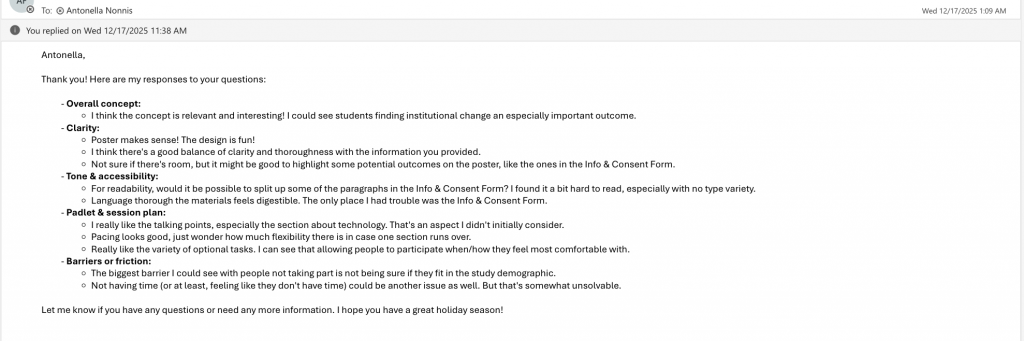
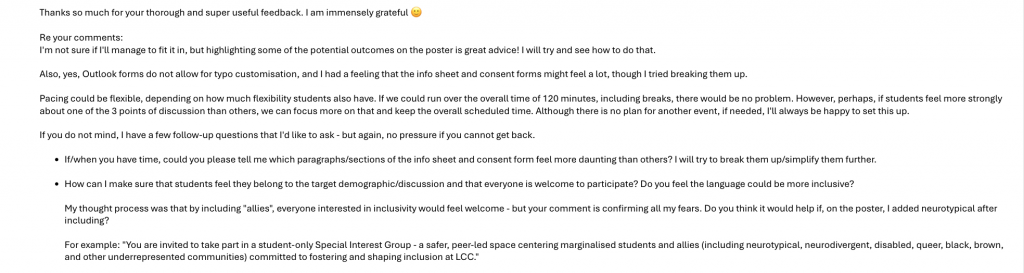
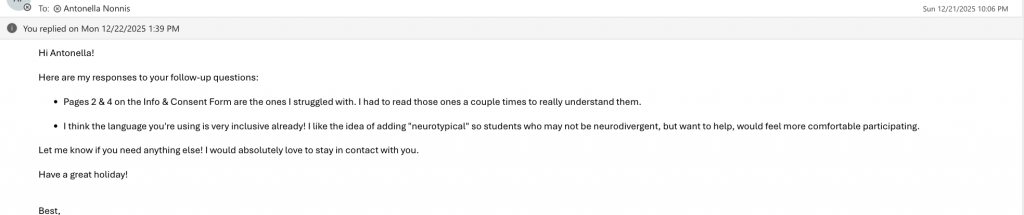
The consolidated framework presented below, has been generated from the raw data displayed above. Responses were analysed using a qualitative content analysis approach, focusing on recurrent themes related to relevance, clarity, tone, accessibility, and perceived engagement among other. Given the small sample size and the formative purpose of this data collection (piloting materials rather than evaluating participant experience), this approach was selected to support reflective iteration rather than theory generation. A thematic analysis of values such as belonging, inclusivity, empowerment etc.. has been coded mostly explicitly from the data (Wæraas, 2022).
Consolidated Coding Framework
I started the coding process considering my existing questions as initial categories but I then tailored them to the data:
- Relevance / usefulness
- Suggestions / concerns
- Clarity of materials
- Tone & accessibility
- Comfort & safety
- Engagement & pacing
Pictures of the printed raw data used for analysis are attached below.
8 Main Themes (A – H) were generated from the analysis:
- Theme A: Perceived relevance and value of the intervention
- Theme B: Scope, focus, and feasibility
- theme C: Clarity and accessibility of materials
- Theme D: Tone, language, and framing
- Theme E: Padlet, activities, and engagement
- Theme F: Inclusivity, accessibility, and lived experience
- Theme G: Barriers to participation
- Theme H: Recruitment, dissemination, and sustainability
Quotes from participants were extracted as illustrative evidence, code labels and descriptors are all shown for each of the Themes generated in the below tables (Theme A to Theme H).
| Code | Code label | Description (merged) | Sources | Illustrative evidence |
|---|---|---|---|---|
| A1 | Intervention relevance | Intervention perceived as relevant, useful, and timely | All | “really great project” (Valerie); “relevant and interesting” (Maya) |
| A2 | Institutional value | Seen as having potential impact beyond the session | Valerie, Jess, Emma | “useful for the university” (Valerie); “co-created spaces” (Jess) |
| A3 | Empowerment potential | Session framed as empowering student voice | Valerie, Jess | “giving them a voice” (Valerie); “fosters empowerment and community” (Jess) |
| Code | Code label | Description | Sources | Evidence |
|---|---|---|---|---|
| B1 | Risk of over-scope | Concern that intervention covers too much | Valerie, Emma | “it’s a lot” (Valerie); “trying to do too much” (Emma) |
| B2 | Need for prioritisation | Suggestion to reduce or select fewer topics/questions | Valerie, Emma | “maybe keep maybe one one question” (Valerie); “focus on one area” (Emma) |
| B3 | Time constraint awareness | Recognition of limited session time | Valerie, Emma | “very limited time” (Valerie); “hard to know how much you’ll get through” (Emma) |
| B4 | Flexibility within plan | Desire for adaptability emphasised | Valerie, Maya | “keep maybe one one question or two for each section and then use the the others as as prompt only if you need to” (Valerie); “wonder how much flexibility there is” (Maya) |
| Code | Code label | Description | Sources | Evidence |
|---|---|---|---|---|
| C1 | Poster clarity | Poster content understood and accessible | All | “poster itself was really clear” (Valerie) |
| C2 | Visual design supports access | Visual elements aid navigation and tone | Valerie, Jess, Maya | “easy to navigate” (Valerie); “calm and welcoming” (Jess); |
| C3 | Information density | Materials perceived as content-heavy | Valerie, Emma, Jess | “a LOT of content” (Emma); “5 pages felt a bit daunting” (Jess) |
| C4 | Information sheet and Consent Form readability | Mixed readability; some sections demanding | Valerie, Maya | “requires more reading” (Valerie); “hard to read” (Maya) |
| C5 | Specific clarity gaps | Missing or unclear information identified | Valerie, Jess | contact details (Valerie); “What does SIG stand for?” (Jess) |
| C6 | Repetition for usability | Repeating key info such as contact details improves accessibility | Valerie | “might as well repeat it” |
| Code | Code label | Description | Sources | Evidence |
|---|---|---|---|---|
| D1 | Appropriate tone | Tone perceived as balanced and suitable | All | “all good” (Emma); “can be taken seriously” (Jess) “feels digestible” (Maya) |
| D2 | Formality as legitimacy | Formal tone seen as conferring seriousness | Jess | “gives you the sense that this is proper and can/will be taken seriously” |
| D3 | Framing risks | Wording may unintentionally alienate | Jess | “‘Staff will be excluded’… does this imply staff will be a threat?” |
| D4 | Inclusivity of language | Language generally inclusive | Maya, Jess | “language… inclusive already” (Maya) “they are really well judged and accessible questions I think” (Jess) |
| D5 | Demographic ambiguity | Uncertainty about who the session is for | Maya | “The biggest barrier I could see with people not taking part is not being sure if they fit in the study demographic” |
| Code | Code label | Description | Sources | Evidence |
|---|---|---|---|---|
| E1 | Padlet comfort | Padlet perceived as safe and accessible | Valerie, Emma, Maya | “Padlet yes” (Emma); “so the padlet is for you to collate information…I’ll get that. That’s fine…if it’s for you to upload stuff, then that’s fine, but they will be uploading only” (Valerie) |
| E2 | Tool purpose clarity | Need to clarify Padlet’s role | Valerie, Jess | “what is it for exactly?” (Valerie) |
| E3 | Multimodal participation | Value of varied participation formats | Valerie, Maya | different modalities “I think it’s a great idea” (Valerie) “really like the variety of tasks” (Maya) |
| E4 | Engagement of activities | Activities seen as engaging | Emma, Maya | “engaging” (Emma); “really like the talking points” (Maya) |
| E5 | Visibility of questions | Suggestion to foreground questions | Jess, Valerie | “make them a little bigger” (Jess) “will you have some of your questions on padlet before you send it to them because ..I know that I always struggle with that when people ask me big questions and I have to think on the cuff like that I need to” (Valerie) |
| Code | Code label | Description | Sources | Evidence |
|---|---|---|---|---|
| F1 | Cognitive accessibility | Need for reflection time acknowledged | Valerie | “prefer to have the questions before” (Valerie) |
| F2 | Conflicting access needs | Recognition of divergent accessibility needs | Valerie | “different people with different disabilities will have sometimes conflicting needs” (Valerie) |
| F3 | Policy–practice gap | Gap between policy and lived experience | Valerie | “and their idea of helping of supporting disabled people was to basically, and I don’t think the university did” (Valerie) |
| F4 | Accessibility as systemic | Barriers framed as institutional, not individual | Valerie | “it was unfair on her as well because she was feeling like, really awkward about it.” |
| F5 | Belonging and allies | Need to explicitly welcome allies | Maya | “adding ‘neurotypical’ would help” |
| Code | Code label | Description | Sources | Evidence |
|---|---|---|---|---|
| G1 | Time as barrier | Time pressure discourages participation | Maya, Valerie | “feeling like they don’t have time” (Maya) “It’s a tricky time because they’ve got deadlines” (Valeire) |
| G2 | Uncertainty about fit | Hesitation due to unclear eligibility | Maya | “not sure if they fit” |
| G3 | Cognitive overload | Volume may overwhelm participants | Valerie, Maya | “it’s covering a lot” (Valerie) “..would it be possible to split up some of the paragraphs” (Maya) |
| G4 | Language misinterpretation | Risk of wording causing discomfort | Jess | “staff will be excluded” |
| Code | Code label | Description | Sources | Evidence |
|---|---|---|---|---|
| H1 | Recruitment complexity | Recruitment recognised as difficult | Valerie, Emma | “no magic way” (Valerie) “At the end of the day it really just depends what students you get for your session.” (Emma) |
| H2 | Multi-channel recruitment | Value of posters, emails, face-to-face | Valerie | “I think that’s a great idea. Yeah. Yeah, yeah. I think so, because also it becomes more kind of, there’s already a connection” (Valerie) |
| H3 | Timing sensitivity | Recruitment timing affects engagement | Emma | “tricky time of year” (Emma) |
| H4 | Collegial support | Offers of help from colleagues | Valerie, Emma | “I could support recruitment” (Valerie) |
Analysis
Across all sources, the consolidated data show strong agreement on:
- High relevance and value
- Strength of participatory, multimodal design
- Need to manage scope, pacing, and cognitive load
- Importance of clarity around belonging and inclusion
- Risk of unintentional exclusion through wording
Differences emerge mainly between:
- Staff focus: feasibility, institutional impact, scope, less info
- Student focus: readability, belonging, demographic clarity, additional info
The analysis of the combined feedback reveals a clear and systematic distinction between how staff participants (Valerie, Emma, Jess) and the student participant (Maya) engage with and evaluate the intervention. These differences are not contradictory; rather, they reflect positional perspectives shaped by institutional role, responsibility, and lived experience.
1. Focus on feasibility versus focus on experience
Staff focus:
Staff feedback is consistently oriented toward feasibility, manageability, and implementation constraints. Valerie and Emma repeatedly emphasise:
- the risk of over-scoping,
- limited time available within the session,
- the practical challenge of managing complex discussions within institutional boundaries.
For example, Emma questions whether the intervention is “trying to do too much,” while Valerie repeatedly suggests reducing, prioritising, or staging questions due to time and cognitive load.
Student focus:
Maya’s feedback, by contrast, centres on the experience of participation rather than delivery. Her concerns relate to:
- readability of materials, suggested to “split up some of the paragraphs“,
- whether she would feel she “belongs” in the study,
- whether participation feels manageable alongside existing time pressures.
Staff evaluate the intervention as something to run; students evaluate it as something to enter. This difference highlights that feasibility for facilitators does not automatically translate into accessibility for participants.
2. Conceptual scope versus personal clarity
Staff focus:
Staff engaged with the conceptual breadth of the project. Emma suggests narrowing the focus (e.g. concentrating on technology), while Valerie reflects on distinctions between “learning experience” and “student experience.” These reflections position the intervention within wider pedagogical, institutional, and research frameworks.
Student focus:
Maya does not question conceptual framing at this level. Instead, her feedback focuses on:
- which sections of the information sheet are hard to understand,
- how paragraphs are structured,
- whether terminology and framing clearly indicate who the session is for.
Staff assess conceptual coherence and research design; the student assesses immediate intelligibility. This suggests that conceptual clarity at a design level does not guarantee clarity at a participant level.
3. Institutional awareness versus demographic uncertainty
Staff focus:
Staff demonstrate a high level of institutional literacy. Valerie and Jess reference:
- policy constraints,
- regulatory limits,
- structural barriers beyond individual control.
Their concerns often assume familiarity with how institutions function and where power resides.
Student focus:
Maya’s feedback reveals uncertainty about eligibility and belonging, expressed as:
“not being sure if they fit in the study demographic.”
She identifies this uncertainty as a potential barrier to participation.
While staff focus on what institutions allow, students focus on whether they are allowed to be present. This highlights that inclusion is not only structural but also symbolic and communicative.
4. Discursive framing: protection versus invitation
Staff focus:
Jess raises concerns about the phrasing “staff will be excluded,” questioning whether this frames staff as a “threat” or implies prior silencing. This reflects a sensitivity to discursive positioning and institutional politics.
Student focus:
Maya responds to framing in terms of welcome and reassurance, suggesting explicit inclusion of “neurotypical” allies to signal openness and welcoming.
Staff scrutinise how language positions groups relative to power; students attend to whether language invites or deters participation. Both are concerned with inclusion, but at different discursive levels.
5. Time pressure as logistics versus lived constraint
Staff focus:
Staff refer to time as a logistical constraint:
- limited session duration,
- difficulty fitting content into allocated time,
- recruitment timing around the academic calendar.
Student focus:
Maya frames time as a personal and affective barrier:
“not having time (or at least, feeling like they don’t have time).”
Staff conceptualise time as a resource to manage; students experience time as a pressure that shapes willingness to engage. This difference suggests that designing for time efficiency alone may not address perceived burden.
6. Positivity and critique: balance versus entry safety
Staff focus:
Both Valerie and Jess caution against an overly critically-focused approach, advocating for identifying “what works” alongside challenges. This reflects staff concern with:
- actionable outcomes,
- sustainability,
- institutional learning.
Maya does not raise this issue directly. Her feedback implies that psychological safety and clarity are prerequisites before critique or positivity can even occur.
Staff seek balance in analytical outcomes; students prioritise safety and comprehension as conditions for participation.
The divergence between staff and student focus demonstrates that inclusive intervention design requires addressing two distinct but interconnected layers:
- Operational inclusivity (staff perspective):
Ensuring the intervention is feasible, bounded, institutionally aware, and capable of producing actionable outcomes. - Experiential inclusivity (student perspective):
Ensuring participants feel they belong, can understand what is being asked of them, and do not experience unnecessary cognitive or emotional barriers to entry.
The data suggest that staff-designed inclusivity initiatives risk unintentionally reproducing exclusion if participant-facing clarity and belonging cues are not foregrounded alongside conceptual robustness.
Grounded in the findings, the intervention would benefit from:
- Explicit signalling of who is welcome and why (student-led concern),
- Continued scope management and prioritisation (staff-led concern),
- Treating clarity, readability, and framing as core inclusion mechanisms, not secondary design features.
Following the suggested edits, raised issues, and friction points highlighted by the four participants the resources, including the poster, info sheet and consent forms, Padlet, and the workshop session outlined structure have been edited and simplified to hopefully enable student’s better experience once recruitment starts (around mid of January ’26). I still need to edit the poster following Maya’s suggestions to add to it. Maya liked the idea of adding “neurotypical” to let students who are allies feel more explicitly included and also said that “it might be good to highlight some potential outcomes on the poster, like the ones in the Info & Consent Form”. While I managed to add neurotypical to the poster I didn’t find the space to introduce the outcomes.
Discussion
This action research project set out to explore the design and feasibility of a student-led Workshop focused on inclusivity, accessibility, and institutional change within LCC. Feedback from staff colleagues (Valerie, Emma, Jess) and a BA student (Maya) reveals a productive tension between operational feasibility and experiential accessibility. It can be argued that this tension is not a limitation of the intervention, but rather an expression of the power relations, epistemic positions, and value negotiations that shape participatory work in higher education.
By situating these findings within existing literature on student voice (Wolgemuth et al., 2024; Welton et al., 2022; Domínguez et al., 2022; Taylor and Robinson, 2009), intersectionality (Crenshaw, 2013; Le, 2024; Brontsema, 2004), inclusive design (Friedman, and Hendry, 2019; Hanington and Martin, 2019; Milton, Martin and Melham, 2016; Lidwell, Holden and Butler 2010), and participatory research (Burke, 2013; McTaggart, Nixon, and Kemmis, 2016), and following Wæraas’ (2022) discussion of values work as the ongoing articulation and negotiation of values through texts, the intervention can be understood as a site where values around inclusion, care, and feasibility are made visible and contested.
Staff and student perspectives as situated knowledge
The analysis highlights a clear divergence between staff and student feedback, reflecting what Braun et al., (2023) describe as the situated and reflexive nature of meaning-making. Staff respondents primarily evaluated the intervention through lenses of scope, feasibility, time, and institutional constraint, while the student focused on belonging, clarity, and accessibility at the point of entry.
This distinction aligns with Ahmed’s (2012) critique of institutional diversity work, where those positioned closer to organisational responsibility often focus on what is possible within systems, while marginalised participants focus on whether those systems are habitable. Staff feedback reflects an implicit concern with delivery; student feedback foregrounds experience.
Rather than interpreting this divergence as disagreement, this analysis supports Taylor and Robinson’s (2009) argument that student voice initiatives must recognise unequal power relations and epistemic authority. The data suggest that staff and students are not responding to the same intervention in the same way, because they are not positioned equally within it.
Feasibility, scope, and the politics of containment
Staff concerns about the intervention “doing too much” resonate strongly with Macfarlane, Bolden and Watermeyer’s (2024) discussion of pragmatist leadership in higher education, where innovation must be tempered by institutional realities. Valerie and Emma repeatedly emphasise time constraints, cognitive load, and the risk of over-scoping, concerns that are legitimate within action research cycles that prioritise sustainability and iteration (McTaggart, Nixon and Kemmis, 2016).
However, these concerns also echo what Mountz et al. (2015) describe as the neoliberal compression of academic time, where participatory, reflective work must be justified through efficiency. The staff focus on containment contrasts with the student emphasis on whether the space feels safe and intelligible enough to enter at all.
This raises a critical question: feasible for whom?
As Burke (2013) argues, access to higher education is not only about formal inclusion, but about the right to meaningful participation. An intervention that is operationally feasible but experientially exclusionary risks reproducing the very inequities it seeks to address.
Accessibility as relational, not just technical
Student feedback foregrounds accessibility not as a technical compliance issue, but as a relational and affective experience. Maya’s difficulty with specific sections of the information sheet, uncertainty about whether she “fits” the demographic, and concern about time all speak to what Lynch (2010) describes as the hidden labour of navigating uncaring systems.
This aligns with Milton’s (2012) “double empathy problem” and Rosqvist et al.’s (2022) work on epistemic injustice, which emphasise that misunderstandings around accessibility often stem from mismatched assumptions rather than individual ‘deficits’1. Maya’s request for clearer signals of inclusion (e.g. explicitly naming neurotypical allies) illustrates how belonging must be actively communicated, not assumed.
Staff participants, by contrast, tended to conceptualise accessibility in structural terms, policies, regulations, systems, mirroring Friedman and Hendry’s (2019) account of value sensitive design, where values must be surfaced and negotiated explicitly rather than embedded implicitly. The intervention therefore becomes a space where values around care, inclusion, and legitimacy are actively contested (Wæraas, 2022).
Student voice, power, and the limits of invitation
Both staff and student feedback engage with the politics of student voice, albeit differently. Staff emphasise empowerment and institutional learning, echoing Welton et al. (2022) and Domínguez et al. (2022), who caution that student voice initiatives often risk becoming symbolic if they do not redistribute power.
Maya’s hesitation about belonging suggests that being invited is not equivalent to feeling authorised to speak. This supports Boler’s (1999) pedagogy of discomfort, in which participation requires navigating fear, uncertainty, and vulnerability. The intervention’s framing as a “student-only space” was intended to protect participants, yet Jess’s concern about how this exclusion is phrased demonstrates how protective measures can inadvertently create new tensions.
This reflects Ahmed’s (2012) argument that inclusion often generates new forms of exclusion, particularly when boundaries are not carefully articulated. The data suggest that clarity of intent and clarity of invitation are as important as the structural design of the space itself.
Creative and participatory methods as ethical practice
The strong endorsement of multimodal activities, Padlet use, and flexible participation aligns with Kara’s (2015) and Wolgemuth et al.’s (2024) advocacy for creative and participatory qualitative methods. Both staff and student respondents valued the availability of multiple modes of engagement, reinforcing Ahmed et al.’s (2024) findings that visual and participatory methods can surface experiences that traditional verbal approaches may obscure.
However, Valerie’s concern about conflicting access needs highlights the ethical complexity of participatory design, echoing Fox’s (2025) and Le’s (2024) intersectional critiques of accessibility. Inclusion is not additive; it is negotiated, partial, and sometimes contradictory. Recognising this tension is itself a form of ethical reflexivity.
Implications for action research practice
From a critical participatory action research perspective (McTaggart et al., 2016), in my opinion, the divergence between staff and student feedback should not be resolved but held productively. The findings suggest that the next iteration of the intervention should:
- Treat clarity, framing, and belonging cues as central design features rather than peripheral refinements.
- Acknowledge time and scope constraints without allowing them to override experiential accessibility.
- Make values explicit, particularly around inclusion, safety, and participation, rather than assuming shared understanding.
In this sense, the intervention functions not only as a pedagogical space, but as a micro-site of institutional critique (Pereira, 2017; Phipps, 2022), where the contradictions of inclusivity work in the neoliberal university become visible.
Conclusion
The differences between staff and student feedback do not indicate a failure of alignment, but rather expose the layered realities of inclusive pedagogical design. Staff focus on feasibility reflects institutional responsibility; student focus on belonging reflects lived experience. Bringing these perspectives into dialogue is not only necessary for the success of the intervention, but central to its ethical and political purpose.
As hooks (1994) argues, education as a practice of freedom requires discomfort, reflexivity, and a willingness to listen differently. This action research process demonstrates that inclusive design is less about perfect solutions and more about sustaining spaces where competing needs, values, and voices can coexist.
References:
Ahmed, M.F., Ali, K., Mann, M. and Sibbald, S.L., 2024. Thematic analysis of using visual methods to understand healthcare teams. The Qualitative Report, 6(29), p.1.
Ahmed, S. (2012) On Being Included: Racism and Diversity in Institutional Life. Duke University Press, Durham, NC.
Boler, M., 1999. A pedagogy of discomfort: Witnessing and the politics of anger and fear. Feeling power: Emotions and education, pp.175-203.
Brontsema, R. (2004) ‘A queer revolution: Reconceptualizing support for queer youth’, Journal of Gay & Lesbian Issues in Education, 1(2), pp. 25–40.
Braun, V., Clarke, V., Hayfield, N., Davey, L. and Jenkinson, E., 2023. Doing reflexive thematic analysis. In Supporting research in counselling and psychotherapy: Qualitative, quantitative, and mixed methods research (pp. 19-38). Cham: Springer International Publishing.
Burke, P.J. (2013) The Right to Higher Education: Beyond widening participation. Routledge, London.
Crenshaw, K. (2013) ‘Mapping the Margins: Intersectionality, Identity Politics, and Violence against Women of Color’, in Feminist Legal Theory. Routledge, London.
DeVito, M.A., Lustig, C., Simpson, E., Allison, K., Chuanromanee, T., Spiel, K., Ko, A., Rode, J., Dym, B., Muller, M. and Klaus Scheuerman, M., 2021, May. Queer in hci: strengthening the community of lgbtqia+ researchers and research. In Extended Abstracts of the 2021 CHI Conference on Human Factors in Computing Systems (pp. 1-3).
Domínguez, A.D., Clement, V. and Bertrand, M., 2022. The bind of unilateral power dynamics and youth voice in school politics. Educational Policy, 36(1), pp.169-198.
Fox, J., (2025). Neuro-queering feminism: Creating space within feminism to address autistic experiences of gender oppression. Feminism & Psychology, p.09593535241306532. (Accessed: 5 July 2025).
Friedman, A. and Nash-Luckenbach, J. (2024) ‘Resistance and power: Gender equality policies in universities’, Politics & Gender, 20(1), pp. 1–21.
Friedman, B. and Hendry, D.G., 2019. Value sensitive design: Shaping technology with moral imagination. Mit Press.
Hanington, B. and Martin, B., 2019. Universal methods of design expanded and revised: 125 Ways to research complex problems, develop innovative ideas, and design effective solutions. Rockport publishers.
Harris, K.A., 2022. Embracing the silence: introverted learning and the online classroom. Spark: UAL Creative Teaching and Learning Journal, 5(1).
hooks, b. (1994) Teaching to Transgress: Education as the Practice of Freedom. Routledge, New York.
Le, L., 2024, October. ” I Am Human, Just Like You”: What Intersectional, Neurodivergent Lived Experiences Bring to Accessibility Research. In Proceedings of the 26th International ACM SIGACCESS Conference on Computers and Accessibility (pp. 1-20).
Lee, C. et al. (2023) ‘The complexities of learner-teacher power relations in universities’, Journal of Higher Education Policy and Management, 45(3), pp. 301–318.
Lidwell, W., Holden, K. and Butler, J., 2010. Universal principles of design, revised and updated: 125 ways to enhance usability, influence perception, increase appeal, make better design decisions, and teach through design. Rockport Pub.
Lynch, K. (2010) ‘Carelessness: A hidden doxa of higher education’, Arts and Humanities in Higher Education, 9(1), pp. 54–67.
Kara, H., (2015). Creative research methods in the social sciences. (Vol. 10). Bristol: Policy Press.
Macfarlane, B., Bolden, R. and Watermeyer, R. (2024) ‘Three perspectives on leadership in higher education: Traditionalist, reformist, pragmatist’. Higher education, 88(4), pp.1381-1402.
McTaggart, R., Nixon, R. and Kemmis, S., 2016. Critical participatory action research. In The Palgrave international handbook of action research (pp. 21-35). New York: Palgrave Macmillan US.
Milton, D., Martin, N. and Melham, P., 2016. Beyond reasonable adjustment: autistic-friendly spaces and Universal Design. Pavilion.
Milton, D. E. M., 2012. On the ontological status of autism: The “double empathy problem.” Disability and Society 27, 6 (2012), 883–887.
Mountz, A. et al. (2015) ‘For Slow Scholarship: A Feminist Politics of Resistance through Collective Action in the Neoliberal University’, ACME: An International Journal for Critical Geographies, 14(4), pp. 1235–1259.
Pereira, M.D.M. (2017) Power, Knowledge and Feminist Scholarship: An Ethnography of Academia. Routledge, London.
Phipps, A. (2022) Women in Academia: What’s the Problem? Policy Press, Bristol.
Redman-MacLaren, M., Mills, J. and Tommbe, R., 2014. Interpretive focus groups: A participatory method for interpreting and extending secondary analysis of qualitative data. Global Health Action, 7(1), p.25214.
Rosqvist, H.B. et al. (2022) ‘Neurodivergent Academic Experiences: Intersections of Ableism and Epistemic Injustice’, Disability & Society, 37(1), pp. 1–18.
Taylor, C. and Robinson, C., 2009. Student voice: Theorising power and participation. Pedagogy, Culture & Society, 17(2), pp.161-175.
Tildesley, R., Lombardo, E. and Verge Mestre, T. (2022) ‘Power struggles in the implementation of gender equality policies: The politics of resistance and counter-resistance in universities’, Politics & Gender, 18(1), pp. 94–123.
Wæraas, A., 2022. Thematic analysis: Making values emerge from texts. In Researching values: Methodological approaches for understanding values work in organisations and leadership (pp. 153-170). Cham: Springer International Publishing.
Wolgemuth, J.R., Guyotte, K.W. and Shelton, S.A. eds., 2024. Expanding approaches to thematic analysis: Creative engagements with qualitative data. Taylor & Francis.
Welton, A. D., Mansfield, K. C., & Salisbury, J. D. (2021). The Politics of Student Voice: The Power and Potential of Students as Policy Actors. Educational Policy, 36(1), 3-18. https://doi.org/10.1177/08959048211059718 (Original work published 2022)
Wilkinson, E., (2025). Feminist pedagogy in the neoliberal university: on violence, vulnerability and radical care. Gender and Education, pp.1-16.
Footnotes
- I used single inverted commas to display my disagreement with normative terms used in the article (i.e., deficits) to reflect on the normalised use of ableist language critically ↩︎